


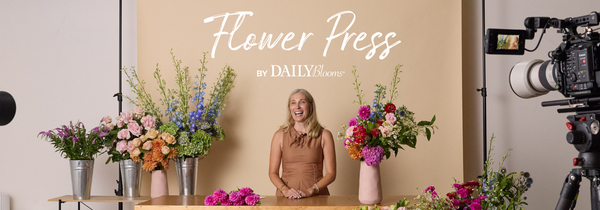
Flower Press by Daily Blooms | Building a Brand With Heart: Alison Long, Founder of Feather & Noise
In this episode of Flower Press by Daily Blooms, Courtney Ray, Founder & CEO of Daily Blooms, welcomes Alison Long, Founder of Feather & Noise, to the floristry bench as they create a floral arrangement together and explore why authenticity, community and genuine relationships remain at the heart of every great brand.
From growing Feather & Noise into one of Australia's most loved fashion retailers, Alison shares the lessons she's learnt about building an authentic brand, creating a loyal customer community and leading with purpose. Together, Courtney and Alison discuss entrepreneurship, leadership, customer experience, balancing family and business, building trust, and why genuine relationships remain one of a brand's greatest competitive advantages.
Hosted by Courtney Ray, Founder & CEO of Daily Blooms, Flower Press is Daily Blooms' returning interview series, bringing together Australia's most inspiring founders, entrepreneurs and creative leaders through thoughtful conversations about business, leadership, branding, customer experience and Australian founder stories. Now in its third season, the series continues to reflect the values at the heart of Daily Blooms, celebrating life's milestones through meaningful connection, thoughtful flowers and beautifully curated gifts.
Episode Notes
Key Takeaways
- How community became one of Feather & Noise's biggest competitive advantages.
- Why empowering your team builds a stronger business.
- The importance of creating customer loyalty through genuine connection.
- How confidence became central to the Feather & Noise brand.
- Why leading with heart creates brands people remember.
Topics Covered
Leadership
Community Building
Customer Loyalty
Brand Building
Retail
Women in Business
Team Culture
Founder Stories
Transcript
Flower Press — Episode with Alison Long (Feather and Noise)
Courtney: Hello everyone, and welcome to Flower Press. I'm Courtney, the founder and CEO of Daily Blooms. In this episode we chat with the delightful Alison Long, the founder and director of Feather and Noise. Hi, hello!
So let's start with maybe you telling us a little bit about what Feather and Noise is.
Alison: Yeah, absolutely. Feather and Noise is a Melbourne fashion label. We're a fairly contemporary style. We're relaxed, we're effortless. We are loved by many, and all ages — lots and lots of generations.
Courtney: Yeah, I love that. Very much your comfortable clothes that make you feel confident when you get up in the morning.
Alison: Yes, and just effortless. Effortless would be the way I describe it — effortless style.
Courtney: So I love hearing about people's journeys, and especially — well, especially I have a, I don't know, I guess a sweet spot for business journeys. But could you tell us a little bit about your personal journey? Like how FNN started, how it evolved, how it came about, what it looked like way back when?
Alison: Oh gosh, it feels like such a distant memory, but I always love to reflect on how much I loved clothing as a child. So my mum loved clothing, and you know, if I had the slightest little cough she would be like, "You should stay home today, and then we'll go buy something."
Courtney: Oh my gosh, I wish my mum did that! Wow.
Alison: So we would take these little days off together, and then she would want to go to the shops, and she would buy herself something, buy me something. But yeah, loved fashion, and then started teaching actually at uni, and it dropped out pretty quickly. It definitely was not for me, and I loved clothes too much. Went straight to a fashion boutique and started working there. I followed my now husband across to WA, where we also worked in buying and visual merchandising. And I was in the surf industry for a long time. And when it was time — yeah, when it was time to leave WA — we moved back to Melbourne, and I really wanted to... I always wanted to be a sales rep and sell in the surf industry. So I worked for a well-known surf label that I absolutely loved, and I think I spent about six, seven years there. And that was when I got pregnant with Indy, our eldest, who's now nearly 15, and we went on to go on maternity leave, as you do, as you know about.
Courtney: Yeah, of course, yeah.
Alison: And I thought, well, let's not return to that industry, and let's start my very own label — after lots of visual merchandising experience, lots of buying experience, lots of love of fashion, and just love of people and community.
Courtney: Wow. Oh my gosh, I had no idea.
Alison: Yep, that's how Feather and Noise started.
Courtney: That's an incredible story. Like, that's quite a brave thing to do. Did it feel brave, or did it feel like it was...?
Alison: It felt really right at the time, you know. We were all wearing clothes that were really just not fitting right — they didn't feel right, they weren't comfortable, and they were a little bit hard to get, sort of thing. They were either very high-end, very pricey, or if they were really cheap, they were really cheap and just not on trend.
Courtney: Yes.
Alison: So it was this beautiful opportunity to invest in our first, I think maybe $2,000 worth of knitwear, take it to a Torquay market, and the last jumper sold off my back. We sold our whole range out.
Courtney: At a Torquay market? Yeah, I didn't know — I grew up in that neck of the world.
Alison: Wow, there you go.
Courtney: That's incredible. The Torquay market — was that because of the surf background?
Alison: Back in the day, that was where all the surf brands were.
Courtney: Yeah, yeah.
Alison: Well, there was a connection. There was definitely a friend in the surf industry who was living down that way who said, "Come along, come to this market." It might have been $100 to go to it, you know, to participate, and yeah, I took the first collection along, and it was a sellout success.
Courtney: Oh my gosh.
Alison: And so the rest is history from that point.
Courtney: Yeah, I think so. I mean, I remember being about six months pregnant and thinking, should I just try and clear these last three or four pieces? We'll pack up, and if we can relaunch the following summer, so be it.
Courtney: Yeah, yeah, wow. And so, is that what you did? You kind of pressed pause whilst you were pregnant?
Alison: Yeah, I carried through the first few collections that winter while I was pregnant with Maya. So I had a 20-month-old at home. Maya was born in the August, had a little bit of a break, and I think by September I was already releasing a new summer collection. So it was pretty quick.
Courtney: It was really quick.
Alison: I juggled the two under two for a...
Courtney: Oh my gosh, yeah, two under two. Yeah, I had the same. Yeah, what's your gap?
Alison: Yeah, two under two — 19 months.
Courtney: Yeah, 21 months. It's actually mental.
Alison: Yeah, it's brutal.
Courtney: It's brutal. Oh my gosh, I had no — yeah.
Alison: So the early days were... were so much fun, because you're running on this crazy adrenaline. You know, you're running on fumes. You want to be more than just a mom. You want to do something for yourself. You're looking at credit card bills, and you're thinking, well, how can I generate an income whilst I'm staying at home? And yeah, how can I bring this community together?
Courtney: Wow. So it sounds like back in those early days you were doing a lot, running on fumes, doing an awful lot. But now you have a big, successful, amazing business with lots of staff, a warehouse, office, styling suite, people lined up on the weekends to go inside. What does your typical day look like for you now?
Alison: Yeah, I feel like I'm a little bit different to the early days, definitely, where you were juggling it all yourself. But I definitely in those early days knew that I needed help and support, and employing the right people... So whilst I — I'm definitely not a control freak in any way, and I love watching my team just blossom and own it, and take the ownership and really just run with their roles. So in the very early days I was like, if I can hire people much better than what I am, I will do so, but they needed to be the right fit. So they had to have, you know, great personalities and obviously really want to be there, and really want to grow this brand together and love the brand. One of our first-ever staff members is essentially still with us as a contractor now, but she's a stylist. She's gone on to have her two babies. So there's some really beautiful stories. There's some staff that have been with us for seven, eight years, five years — a really long time. People stick around at Feather and Noise.
Courtney: So they must enjoy it.
Alison: Yeah, I feel the same about Daily Blooms. We've had some people that have been with me for such a long time, and it feels — Daily Blooms is an extension of me, and I feel like it's also an extension of them. We've really got this nice little community of staff.
Courtney: It's amazing when staff can be so loyal.
Alison: And that is absolutely — and outsiders looking in at Feather and Noise, they're like, "Ali, you have the best team." "Oh, how nice is that, like your team's amazing." No one talks about me anymore. They're always like, "Oh, I spoke to Larissa on customer service," and "Oh, Julia on camera, she looked so good," and "Was that her mum who called in and also did camera work with her?"
Courtney: Yeah, oh my gosh — see, that's so special. I feel like that is integral to everything you do at Feather and Noise. I think community, isn't it, community?
Alison: Yeah.
Courtney: And you've done, I think, more — like before anybody was thinking about community, you had already built this great network of people who love your brand, and they feel like family. Like you make it feel like everybody is a friend or a neighbour or a family member. And you've done that forever. Like, I remember looking at your social media back in 2014, where I didn't know anything about social media, and you just got it.
Alison: Yeah, I think we fell into it early. We fell into it early, before influencers were even a thing, collaborations were even a thing. So it became this really natural feeling of like, wow, if I know an artist, or if I know a photographer, or I know a stylist — like, let's help them grow their brand too. Definitely before collaborations were a thing. Really early days. And so people, our audience and our followers, our customers — they really appreciate that, because they remember all those little early days, those early milestones that made FNN what it was.
Courtney: Yeah, absolutely. And so I suppose it's one thing to do that when it's a very — I won't say small brand, but when it's you and a handful of staff members. But as you've grown, like, you've really grown into a really big business with a lot of products and a lot of moving parts. How have you held onto that sense of community? Because if anything, I think you've grown it whilst keeping it really — like, it feels grassroots, but it's big. How do you make that feeling?
Alison: Yeah, sometimes I used to think, do we make ourselves look bigger than what we are? And is this why people like yourself might think that?
Courtney: I don't think so.
Alison: I don't think so either. I think we are big. We are a big business. And you know, I hate using the term "luck," because it hasn't been lucky — it's been hard work. But I also think we were really lucky with our timing. You know, we hit online at a really early stage, before a lot of people were online. We gave people this incredible experience, both online but through social channels. We survived COVID, and you know, took all of that content home — how can we make people feel really special?
Courtney: Yeah, yeah, right.
Alison: And I think bringing in our first-ever proper product designer was a real game changer. So before that it was just me. I think 2023 we brought in our first technical designer — Katie — and she's still with us now, so four years on.
Courtney: Wow. And so what does that mean? I don't know what a product designer is being.
Alison: Yeah, so it's very different — if you're not a qualified designer like myself, I'm more product-based, connected with factories, product design. But "technical" will mean that your jeans will fit a lot better, your shoulder seam on your shirt will drop a lot better. That's how it fits. But also it's a support. It was very hard to be the fit model — and let me say, when I'm the fit model, it's not the model on the website, it's just me fitting everything. Probably similar to a lot of founders — whether you start a shoe label, sunglasses brand, you will put that product on and fit it. So to this day, still I'm the typical fit model on Tuesdays, 9:30.
Courtney: Really? Every week? Oh wow, okay. It's really interesting to hear you talk about bringing in a product designer, because one of the things that I think is really clear to me from the outside — I'll see a social media post and I'll know it's your — I feel like you've got a really distinctive style, and you design clothes with a particular person in mind, and I think maybe that person could be someone like me, like a busy working mum. How have you been able to keep that design aesthetic consistent over all this time, whilst also following trends and updating and building a team?
Alison: There's a lot to be said about trusting your own gut and finding the gaps and the frustrations that you might experience. We will absolutely follow trends at Feather and Noise, but we will always do it in our own wearable way. It just always has to be like — turn it down a little notch, tone it down a little bit. Or if we have a little dabble in a trend, you know, you might reduce your numbers and just make sure that you've got your numbers right, so you don't go too hard too fast. And if it doesn't work out, it can be a bit scary, but we really stay in our own lane. And that's probably the biggest feedback we get from people. They're like, "We love Feather and Noise because it's so timeless." And when I purchased that piece 12 months ago, and then this year I know that I can wear that piece back with the new barrel jean trend, whatever the jean trend is for this season, but I can pull out last year's knit and I know it'll work. So yeah, we like to take people on this journey where if you purchased a bestseller last year and you loved it so much, then hey, here's the update. You know, it's nearly the same — the fabric's going to feel the same, but it might have a stripe down the side this year. But it's got all those same features. It's their trusted go-to.
Courtney: I think so — so if they shop at Feather and Noise, they'll get something that they feel good in, and can be confident that it'll see them through some time.
Alison: I think they like to know who they're buying from as well.
Courtney: Yeah, and a lot like Daily Blooms.
Alison: Oh, I don't know — you do that way better than us. Like, I love — I feel like I love seeing you, your face pop up, and your team, your beautiful team.
Courtney: The team is everything. What would we do without our teams? Oh my gosh, absolutely. So you've touched on this a little bit, but I'd love to just dig a little deeper on the concept of using data as opposed to intuition. How do you see that? It sounds like you've got a bit of a balance.
Alison: Yeah, yeah, I think intuition is based on your customer feedback. Just a little bit — it trickles into your brain. You hear that feedback: "Oh, I'd love that in cobalt blue." "I'd love that in a bright colour." "I'd love a V-neck, because round necks — I feel a bit funny in a round neck." So you sort of hear it trickle in, and then it sits with you for a bit. It's often not always perfectly timed, do you know what I mean? It's that feeling of like, you listen to your customer and you take on that feedback, and it sits with you, and then it pops up at the right time, and you're like, let's pursue it now. So that, combined with the data — is it maybe like a 60/40, you know, 60 intuition? Let's do this, like, give it a go, it'll sell, the people want it. Let's test the waters. And then, you know, the data and the analysts will sit there and go, "Wow, you know what — it's a lot like last year's, it's just a little bit, you know, longer, shorter."
Courtney: Yeah, that's so good. And so how do you listen to your customer feedback? Is it when they're visiting, is it on emails?
Alison: Majority of it is in Instagram DMs.
Courtney: Really?
Alison: Absolutely — they are full of just chatterboxes in there. They love a chat. I would say it definitely blew up during COVID, when everybody was just looking for connections and they were talking online. We actually also have always prioritised paying a social media engagement officer. She clocks on every night, seven till ten — it's just been so important to me, and I could have easily pulled it from the business, but I never wanted to. We've had it in place probably ever since — I did it for the first three years, and then I was like, yeah, it's exhausting. I think — there's so many DMs coming through, I was like, imagine if you could create a role, and this person could work anywhere, and then they can just talk to the community — a real-life person every night on engagement — and you're creating a job for somebody. That's been amazing. So we call her our engagement officer. I love that — over the years we've had multiple uni students take on the role, but right now, as we sit, we have a beautiful girl called Shana who's been with us 12 months, and it is like the highlight of her night. She just loves it — she logs on and she just chats to our community. So all that feedback comes in on DMs — from fit questions, styling, sizing, "When's this coming back?", "When's this launching?", "What was that shirt, Ali, you were in — in that video of Daily —"
Courtney: Oh, of course, you would get — you would get so many questions like that.
Alison: Yeah, that's so interesting. It just means that somebody is there on the other end to answer.
Courtney: Yeah.
Alison: So that has absolutely — people are scrolling, right? Our social media team will do that during the day as well, just at intervals, you know, not like every 10 minutes, but within each hour, quick little check-in. And then the evening crew will complete all the leftover ones that might have not got answered. But they'll also upload the stories too, which is a beautiful part of our community — every single night, three to six story sets are curated, put into Dropbox, ready for our engagement officer to just upload those stories every single night.
Courtney: So clever. I would say, like, when people ask, "How has your social media growth — how has the community been supported by this brand?" — I would say evening engagement has been a massive part. You know, I love doing this series, because I actually learn something every single time that I'm going to implement into Daily Blooms. So with the evolution of Feather and Noise over all these years, your beautiful staff members, your beautiful community — has there been a particular product or collection or moment that really shifted the trajectory of the business?
Alison: Let's talk about a product.
Courtney: Let's talk about a product.
Alison: So there has been a few products over the years that really stand out, but let's hone in on our famous Noah pants.
Courtney: Okay, great.
Alison: They are essentially a wide-leg jogger, a tracksuit pant, elasticated waist, this beautiful kind of fabric that can be easily elevated. Some women wear them out with a heel and a blazer and they look so chic, and then the everyday mum runs around for school drop-off in them. So they're called the Noah Pant. We launched them in 2023, and this is their fourth year. And it's spring, summer, winter, autumn — obviously massive in autumn/winter because of the comfort in the wool. But we started out with plain black, and then black with two white straps, and now there's — I don't even know, there's something like probably 17 different colourways. And then we added a shorter length for the shorties who needed cropped, because everybody was like, "These are too long."
Courtney: I don't — yeah, that's not my problem, you won't have that problem.
Alison: That's not my problem, you'll love the full length.
Courtney: I — a hundred percent.
Alison: So I would say that one product is absolutely phenomenal for our business, and a massive congratulations to our designer Katie — that was her vision early. They are probably everywhere now, and multiple people have probably rolled these pants out too, but I feel like that does happen when you're a bit of a leader — the Noah pant is a household name amongst a lot of busy women.
Courtney: Oh, I'm so happy to hear that, that's amazing. It's always fun at Yarraville Coles or school pickup, things like that, where you're like, "Noah pant, Noah pant, Noah pant, Noah pant." One of my favourite things in the world is when I'm walking through the city, or walking anywhere for that matter, if I see a Daily Blooms bouquet out in the wild — oh my gosh, I just about — you know, straight away I know it, and I can see it coming, and I will clock it, and I cannot tell you how unbelievably exciting it is. The everyday person wouldn't notice how our products are made, but I know just the way they're spiralled and the way that they're constructed — I can see them a mile off.
Alison: But then I also see the packaging — but it would be so much, you would have that way more frequently. Well, my children now catch the train — they're in high school, so they catch the train across the city, and they spot the Feather and Noise —
Courtney: Oh, that's so good.
Alison: — on the back of jeans, like, people on the train.
Courtney: Now that's so good.
Alison: Often, often Indy gets home and will be like, "Oh mum, I literally saw blah blah blah —"
Courtney: Oh my god.
Alison: " — a tote bag at the train station."
Courtney: That's so nice.
Alison: That's — school teachers, you know, on the other side of the city, in the classroom, and she's looking at this top, being like, "That's my mum's, that's so cool."
Courtney: That's so cool.
Alison: And they never say a word — they never say a word, they won't say "That's my mum's top." They keep it very harsh, you know, teenagers.
Courtney: No — yeah, yeah, yeah. Do you think they're going to follow in your footsteps?
Alison: Absolutely not.
Courtney: Okay, got it.
Alison: Maya wants to own a dance studio and be a dance teacher.
Courtney: Wow.
Alison: Indy is turning 15 — she would just love to play netball probably for the rest of her life.
Courtney: Oh, I understand that.
Alison: But you know what — in saying that, it's been really important as a family value to make sure that they are a big part of the business, but they are also a big part of making sure that they know that you have to work really hard to get to where you get, and money doesn't grow on trees.
Courtney: Well, I think they would have seen that.
Alison: Yeah, they have a really good understanding of that. So with Indy turning 15 at the end of the year, since probably last Christmas, she's been in our warehouse and she packs lots of orders when she can.
Courtney: Oh, that's so great.
Alison: She's a sporty girl.
Courtney: That's so great.
Alison: But in school holidays, she'll come and pack for a few hours and pay off some kind of sneaker that she's been desperately wanting.
Courtney: Oh my gosh, I love that so much.
Alison: So yeah, they are a big part of it. And weekends, our whole family — my husband, my two girls — it's not uncommon for them to be in the warehouse and kind of just involve cleaning up, doing a few things.
Courtney: Yeah, that's so good.
Alison: They've been in lots of photo shoots over the years.
Courtney: Oh, that's so nice. That's so cool that they can do that.
Alison: I think in school holidays — I mean, you'll walk into Daily Blooms and you'll think it's a childcare centre.
Courtney: We've got a lot of mums, and there's a lot of kids.
Alison: Oh, I love that too.
Courtney: So as the business has grown and evolved, how has your role as the founder and CEO changed?
Alison: Yeah, look, I would say you can definitely take a really nice step back as a founder when you're hitting that kind of five, six, seven, eight year mark. You can put a lot of trust in your team. I am not a control freak by any means — I am so happy if somebody else can just get it done. And I believe I hire really well — I hire really good humans, people that really care about the brand. I'm still always around for them, but you definitely can go and make that decision today, and I'll let them know you're cool, and that's okay. You know, particularly customer service is such a massive part — like, nobody needs my permission to allow somebody to get a free top because something might have happened, you know — go for it. Any decision is better than no decision. I always say to the team, "Somebody make a decision," and they do — they're real leaders. And we've structured the team with this department leader's role, where every department — doesn't matter if the department's really small, even if there's only two people in it — somebody can be the department leader, you know, and so they have their own little team. The social media team has a department leader with a couple of team members under her.
Courtney: Which really frees up you.
Alison: Yes, absolutely — then all I have to do is go to the key department leaders, and then they can filter it down into the teams.
Courtney: Amazing. And that sounds really massive, like there's all these big teams —
Alison: It's not — some of these teams have two people in them. Warehouse might have 10 people, but somebody needs to be in charge in every department, and then it just can flow really nicely. And then it allows for a lot of development too — so that if somebody was to tap out and end up wanting to finish up, there's that feeling of like, "Oh, I could go for her role." And that's happened over the years.
Courtney: You just seem so good at putting structures into your business.
Alison: Yeah, I think so — I hope so.
Courtney: You are, you really are. I feel like I'm so chaotic in comparison, but that just seems like — even just the structure of people being able to step up into different roles — I love that. I suppose finally, I'd love just to touch on what's next for Feather and Noise?
Alison: Wow, I feel like last year was a massive year of migrating across platforms — so there was a real tech year for us. The year before, we launched wholesale, which really just dipped our toes into it, so we now have — I think we've got like over 100 stores in Australia that are stocking Feather and Noise.
Courtney: What?! Yeah, that's massive.
Alison: Yeah, some of the buyers even turn up in Yarraville here to do a showing, and they'll place their first order and they'll take their stock with them on the day, and they'll take it back down the coast, or they'll take it wherever they need to. Or we'll post it to them, and yeah, they'll put the stock in their stores. So wholesale has been an amazing part of the growth — but also for brand recognition.
Courtney: Yeah, yeah, I'm flabbergasted, really.
Alison: 100%. Yeah, you might not have known that we —
Courtney: Yeah, I actually didn't realise that you did do wholesale, and I also am shocked that in just a short period of time —
Alison: Yeah, yeah, so that's probably been close to about two years. We have two beautiful girls — we have Kate and Carly who run our wholesale team.
Courtney: Oh my gosh, that's so incredible.
Alison: They are kept very busy, those two. So wholesale is a whole other ball game. So I feel like this year we are just kind of embracing the new platforms, focusing on wholesale growth, potentially rolling out a store, and just really enjoying our little styling suite in the meantime. You know, people can come there, it's intimate, it's small, it's cosy, but we'll just see what the year brings.
Courtney: You're so busy, you've got a lot happening.
Alison: Yeah, there's a few moving parts for sure, but we'd be so bored if we weren't busy, right?
Courtney: That's true. Yeah, you always need something new. Okay, at this point it is time for our rapid-fire questions.
Alison: Okay, all right.
Courtney: Favourite season for dressing?
Alison: Autumn/winter.
Courtney: Perfect, love a layer. Early morning person or night owl?
Alison: Night owl — when mothers do their best work.
Courtney: I think I knew that when you replied to my email at 2am, and I thought, have you been to bed, or are you up early?
Alison: I don't know. First app you check in the morning?
Courtney: Instagram.
Alison: A brand you admire?
Courtney: I'm loving By Moja right now. It is a crochet handbag brand — she's relatively new-ish, she's got little boys, I think, like small young children. And you know how crochet is a trend at the moment, so she's crocheting these bags, and it's bringing everything back to homemade again, which feels really special. And she's just collaborating, but not in a really fast-paced way — just very organically. By Moja.
Alison: Okay. A trend you are loving right now?
Courtney: Can I have two?
Alison: Of course, of course.
Courtney: I am loving the check shirt trend — I'm in one today, had to wear it, absolutely love it. Brings back so many memories of growing up with check shirts and all of that. But definitely the funnel neck trend, which is like kind of bomber jackets, the high zip-up neck. So like your trench coats now have a funnel neck — and then they put the hood in — your windbreaker coats have the funnel neck. We've got some good ones coming.
Alison: Okay, that's good. Okay, great. A trend you would happily never see again?
Courtney: Skinny leg jeans.
Alison: Ooh, okay.
Courtney: If you could give a bunch of flowers to anyone in the world, who would it be and why?
Alison: It would be my best friend. She's a local lady — she lost her mum 12 months ago, right on Mother's Day, and I think she deserves them.
Courtney: I think she does too. Yeah, that's really nice. Okay, well, thank you so much.
Alison: Thank you, thank you, thank you.
Courtney: All righty, it's time we'll spin the flowers around so everyone can see our creations. Beautiful — can we bring them in? Yeah. Thank you. My tippy toes.